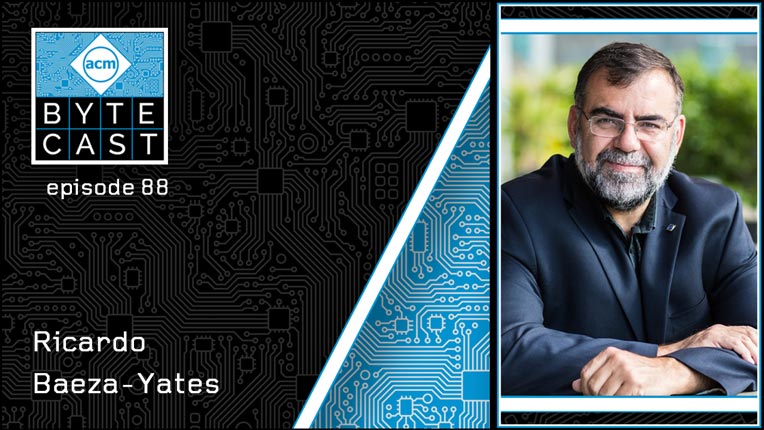

Ep88: Ricardo Baeza-Yates
In this episode of ACM ByteCast, host Juan Miguel de Joya welcomes 2025 ACM Luiz André Barroso Award recipient Ricardo Baeza-Yates, the Search Chief Scientist at You.com, holding part-time professor appointments at KTH Royal Institute of Technology (Sweden), Universitat Pompeu Fabra (Spain), and Universidad de Chile. The award recognizes his pioneering contributions to algorithms and information retrieval as well as his leadership in fostering a vibrant transnational research community across Latin America. Baeza-Yates is widely regarded as one of the world’s foremost researchers in information retrieval, celebrated especially for pioneering innovative data structures that have shaped the field. His work has produced influential algorithms for string searching and fuzzy matching, including the well-known Shift-Or algorithm. As a practitioner, Baeza-Yates served as VP of Research for Yahoo Labs, secured 14 patents, and co-founded several startups in Chile and Spain, including Theodora AI, devoted to mitigating technological bias. Among his honors, he received the CLEI Distinction for Contributions to Computing in Latin America in 2009, the Spanish “Ángela Ruiz Robles” Award for research excellence and entrepreneurship in applied computing in 2018, the 2024 Chilean National Prize for Applied Sciences and Technology, and the first Merit Award from the Chilean Computing Science Society in 2025. Ricardo is a member of Academia Europaea, and a Fellow of ACM and IEEE. He is the co-author of Modern Information Retrieval, which became the field's most cited textbook.
Ricardo shares his unconventional path into computing, from influential teachers to his discovery of the mathematical and logical beauty of algorithms. He discusses his current research, which focuses on evaluating AI by examining failures, harm, and risk rather than simply measuring success, since errors can have profound consequences in fields like medicine and law, where users may not have the expertise to recognize errors. He advocates for combining reliable search with AI to provide AI agents with accurate, trustworthy information. The conversation also explores the limitations and social consequences of increasingly replacing traditional search with AI-generated responses, including the risk of "cognitive offloading." Ricardo also shares his views on how AI is shifting computer science, offers advice for future AI developers, highlighting ACM’s principles for responsible computing, and advocates for more inclusion of Latin American perspectives in computing and AI.